
The Grounds
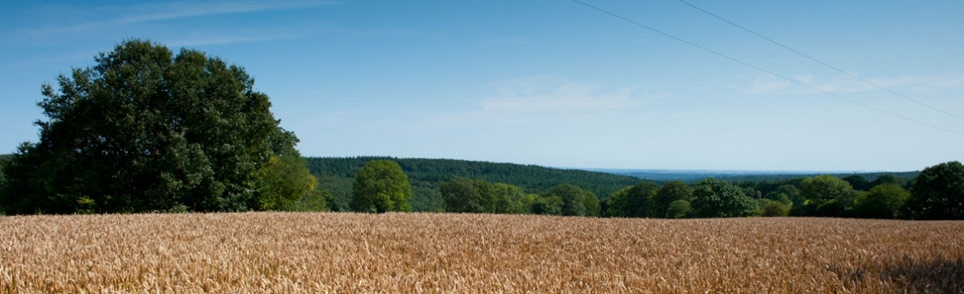
The grounds stand within a Norman deer park (Clebury Park), once owned by King Henry I. This park was later given by Henry VIII to the father of his mistress, the beautiful Bessie Blount, when she gave birth to Henry's eldest son, Henry Fitzroy. (Like his uncle Prince Arthur Tudor, he died before his father, giving rise to the rumoured curse of the Plantagenent "White Queen", whereby all Tudor firstborn sons must die before their fathers) The surrounding countryside is a precious unspoiled relic of medieval landscape, barely changed since Elizabeth I prosecuted the local squire, George Blount, her elder half brother's uncle, for cutting too many of her oak trees, which she needed both for her navy to fend off the Spanish Armada, and to heat her favourite, Robert Dudley's, iron blast furnaces. (He had 2 of these in the Wyre Forest close to the cottage). A recumbent life-size George survives in stone, dressed in ceremonial armour, on top his tomb, in the local church.
Wild Wonderland
Within the wider grounds of Manor Holding, is a wonderland of exciting places for children and adults to explore and curiosities to discover. There are lots of opportunities for creative, educational play and physical activity for all age groups. England's largest woodland National Nature Reserve overlaps the edge of the cottage grounds.
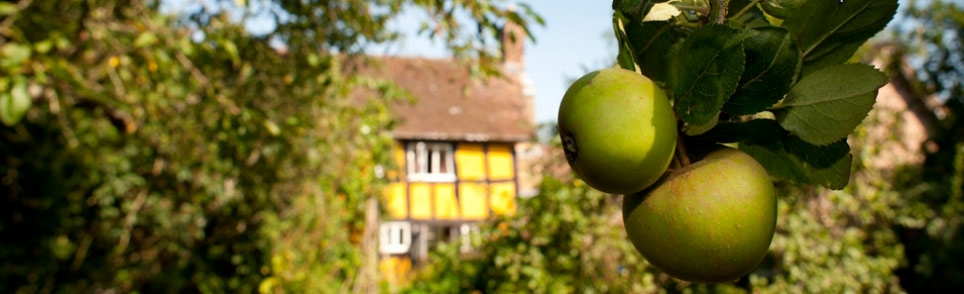
Manor Holding is set in 2ha (5 1/2 acres) of ancient mixed fruit orchards and wildflower meadows. All managed, using sheep grazing to control the vegetation, in accordance with a Higher Level Countryside Stewardship agreement with Natural England. NB. Please note that dogs are not permitted in those fields where sheep are being grazed at the time, but are welcome at other times or elsewhere provided they are kept under control.
Ancient Orchards
These orchards, and the adjacent oak woodland, form part of the Wyre Forest Site of Special Scientific Interest, one of the largest in England. Guests are welcome to pick their own fruit, herbs and vegetables in season. Fruit grown include a wide variety of desert, cooking, and cider apples, pears, cherries, plums, greengages, damsons, sloes, elderberries, peaches, nectarines, figs, blackberries, mulberries, black and red currants, gooseberries, blueberries, strawberries. The last being used as ground cover in the flower beds!
Plus walnuts, hazelnuts, and sweet chestnuts.
The hedgerows are laid in the traditional manner on a 10 year cycle and are protected from the sheep by double fences to encourage development of wildlife corridors linked to the adjacent designated Ancient Woodland, the largest woodland National Nature Reserve in the country.
The hedgerows, grasslands, pond, woodland and ancient fruit trees support a huge variety of wildlife, some of it rare and endangered, as does the surrounding forest.
Wildlife Diversity
Species to look out for include Fallow and Muntjac Deer, Badgers, the brilliant green Noble Chafer (found only in such ancient orchards), Dormice, Shrews, Bats, Bees, Hornets, Damsel and Dragonflies, Newts, Mistletoe, Snowdrop, Bluebell, Cowslip, Fritillary, Wild Garlic (delicious), Toothwort, Woody Nightshade (very poisonous berries), the enormous Shaggy Parasol mushroom and Giant Puffball (both edible but check identification), Kestrels, various Owls, Green Woodpecker, Swallows, Cuckoo, Moths (including the spectacular Scarlet Tiger Moth) and Butterflies, Devil's Coachmen, the brilliant scarlet Black Headed Cardinal Beetle, and many more. You might even see an elusive black Lynx!
The Wyre Forest is famous for a huge diversity of butterflies and moths. Over 140 species of moth have been identified in one night by one local researcher.
Historic Landscape
The geology, history and archaeology of Manor Holding and its immediate surrounds are complex, intriguing and ancient. It stands on a ridgeway likely to date from the neolithic period. In the IronAge period a thriving fortified promontory settlement stood next door on the far side of the ridgeway. The surrounding field system appears to date from this time, expanding slowly by means of a series of 'assarts' won from the surrounding forest up until the middle ages. But with settled times commercial activity moved further up the ridge with Roman and later Saxon farms recorded close to the high point of the ridge. The high value placed on the forest is reflected in the division of the core forest between all the surrounding parishes, thus Manor Holding and adjacent farms became a separate part of the wealthy Stottesdon parish some 5 miles to the NorthWest, with the medieval parish boundary hedge running along the northern boundary of Manor Holding. The Ironage field system around Manor Holding was seized by the Normans following the Battle of Hastings, and converted to a royal deer park, granted to the earl of Warwick, a favourite of King Henry I. In the middle ages various planned villages were constructed close to the high point of the ridge; including the once thriving small industrial town at Earnwood producing coal, iron ore, charcoal and other forest products. However the black death and stricter enforcement of the feudal forest laws by Queen Elizabeth I, led to the relocation of industry further north to Ironbridge, now revered as the birthplace of the industrial revolution and a World Heritage Site. Earnwood, once another royal deerpark, then a centre of industry, was reclaimed by the forest, and faded from history.
Manor Holding and its neighbours still have clear traces of mine shafts, spoil heaps and other earthworks in the fields and adjacent woodland, though these can be hard to spot among the ant hills and vegetation. It is likely that Manor Holding's coal was supplied to Robert Dudley's Tudor blast furnace at Furnace Mill close by at the bottom of the hill. Fresh ancient objects are uncovered each time the garden is dug over. The ancient ridgeway utilised by the cottage drive is now part of a long distance footpath, the Abberley and Malvern Hills Geopark Way, which runs for 109 miles between Gloucester and Bridgnorth. While the cottage's access lane is part of an old, much wider, medieval drove road, and timber extraction route, that skirted around the edge of the old deer park. The surviving lane turns sharp left beyond Manor Holding, along an older Ironage lane within the deer park perimeter. These lanes previously connected with a complex network of forest roads used at varying times in the past, and still traceable in the topography of the forest.