
History of Local Area
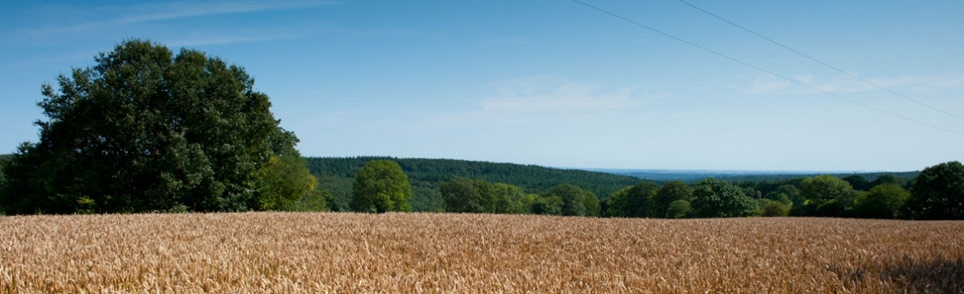
The Wyre Forest is situated at the toe of the foothills of the Welsh mountains, at the western extremity of the great north European plain, which stretches eastward across Russia to the Urals. The area is part of the Welsh Marches, so called after the powerful Marcher Lords who during medieval times protected the western flank of England against the marauding Welsh. It is an area of complex history and geology, separated from the fertile English lowlands by the broad swift flowing River Severn, the longest river in Britain, famous even then for it's Salmon and Elver fisheries.
An early ford of the river at Bewdley gave rise to an established ridgeway track during neolithic times through Kinlet to the Clee Hills over-looking the Teme Valley at Ludlow, and close to this track several farms/settlements became established during the iron age and subsequently Roman times notably at the Roman fort of Wall Town, which still dictates the alignment of the modern road (B4363) between Kinlet and Cleobury Mortimer. A smaller Roman villa stood on top the ridge running south from Catsley Farm ("Cateschesleie" as recorded in Domesday) to Kingswood; where traces of a substantial fortified Iron Age settlement of the "Promontory Fort" type remain overlooking the forest and Severn valley, eastward toward the high ground at Dudley Castle. A shallow ford over Dowles Brook below Kingswood provided a link to the ridge continuing south to hill top settlements at Clows Top, Abberley and the Malvern Hills.
Following the Norman conquest of England, much of south Shropshire including the Wyre Forest was awarded to the Mortimer family, having previously been owned by Queen Edith, the power behind the thrones of both her husband King Edward the Confessor and brother King Harold Godwinson. She was, after the King and Archbishop of Canturbury, the wealthiest person in England prior to the conquest.
Manor Holding's northern boundary hedge previously separated the medieval parishes of: Kinlet (Chinlete in Domesday), owned by Queen Edith and subsequently the Mortimers; and Kingswood, a detached portion of Stottesdon parish, which by 1096 was held from the King by Henry I's subsequent court favourite the Earl of Warwick, Nicholas de Segrave. It reverted to the King during the Plantagenet period, but was then effectively given by Henry VIII to his 'Squire of the Body', Sir John Blount of Kinlet, on the birth of Henry's first (illegitimate) son to the beautiful Bessie Blount, Sir John's second daughter. Sir John being appointed "Keeper of Clebury Park". According to the near contemporary map of Shropshire by Christopher Saxton, (commissioned by Elizabeth I's chief minister Robert Cecil in 1574) Clebery Park included the manors of Kingswood and Winswood. It appears to have abutted the shorter lived Earnwood deer park adjacent to Button Oak, whose boundary hedgebanks had been broken in 1274 by Roger de Mortimer, but remain in part visible as earthworks within the forest.
During the medieval period the wider Wyre Forest (at the time technically a "Chase" until it's owner, Edward IV, acceded to the throne, when it became a "Forest" in the medieval sense of the word) became a centre for industries based on it's coppiced woodland and shallow easily worked coal deposits, both used locally for iron smelting. A thriving industrial town grew up during this period at Earnswood in the centre of the forest, of which now only traces remain in the woods, fields and scattered small holdings of the area North East of and surrounding Manor Holding.
The forest was maintained by royal decree, with the then local squire, Sir George Blount, appointed by Queen Elizabeth I to manage not only Clebury Park, but the whole forest. He was however subsequently prosecuted by the Queen for cutting too many trees. She then conferred the forest management on her favourite, Robert Dudley, earl of Leicester, who not only used the forest to supply oak for her new navy, but also capitalised on its natural resources to establish his iron blast furnace at Furnace Mill, just down the hill from Manor Holding which may have supplied coal from its own two mines (shown as abandoned on the earliest editions of the Ordnance Survey). Helping produce the high quality iron and steel that proved so effective in manufacturing the longer range naval cannon that sank the Spanish Armada. (The inferior Spanish cannon did not have sufficient range to reach the smaller and more agile English ships harrying them at a distance). Dudley also slaughtered all the forest deer to stop them eating the young coppice shoots that he needed for charcoal and tannin production. (Charcoal helps steel weapons hold a sharper edge, while tannin is used to 'tan' leather)
George's sister Bessie Blount was, as mentioned above, mother to Elizabeth's eldest half brother Henry Fitzroy, who sadly died (possibly poisoned by his half sister Mary, whose nickname "Bloody Mary", she bequeathed to the eponymous drink) before his father Henry VIII, to whom he had appeared to be a possible (though illegitimate) heir. Fitzroy's death may have changed subsequent history substantially.
At the culmination of the English Civil War, the Royal Palace at Bewdley was sacked and looted following the massacre of royalists in the nearby "Bloody Hole", a narrow steep sided valley on the edge of Bewdley, at the culmination of the Battle of Worcester (a fast moving battle fought along the banks of the Severn between the towns of Worcester and Bewdley in 1651). This battle ushered in an extended period of relative peace and stability that facilitated a new era of prosperity and and religious tolerance in England.
Our national vigour and dynamism did not increase compassion for those opposed to England's dominance. A major plank in the burgeoning English economy was the recently established transatlantic slave trade. This lucrative trade, which had financed the Parliamentarians against the impecunious King James I, also helped ensure that rebellions in both Ireland and Scotland were swiftly defeated. When somewhat later (1704) Louis XIV, the "Sun King" of France, was defeated by John Churchill, the 1st Duke of Marlborough, a grateful nation built him a sumptuous palace, named Blenheim in honour of his victory, in a nod towards his defeated opponent's opulent Palace of Versailles.
Back in Kinlet Sir George had been succeeded by his eldest sister's son and the family name changed to Lacon and then, following a second lucrative female succession, to Lacon-Childe. The new family emblem became and still is, the Eagle and Serpent, after which the village pub is named.
The repeated acquisition of new family alliances brought great wealth to the Kinlet estate. A splendid new tomb was built within Kinlet church for Sir George and his wife, and then another for his heirs. These still dominate the choir. In 1727 the Tudor Kinlet Hall was demolished and rebuilt in stone in the latest grand Palladian style, while Kinlet village was relocated to make room for a newly "landscaped" parkland.
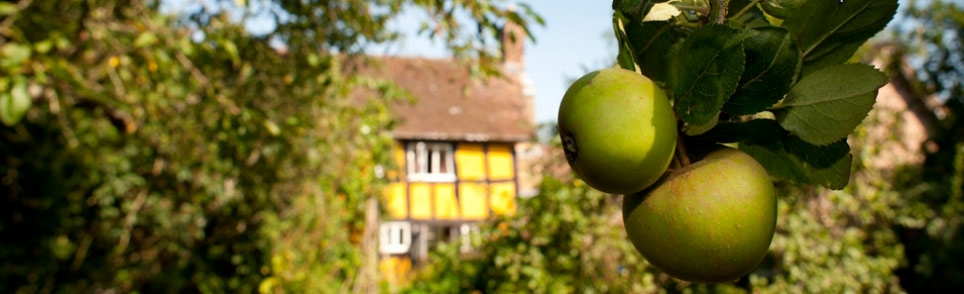
The timber framed wing of Manor Holding is thought to have been built, using second hand timbers from the rebuilt manor house at Winwoods, in the 1680s. And later improved by the addition of glazed windows after 1720; possibly acquired second hand during the relocation of Kinlet village by the new squire as he expanded the parkland setting for his much enlarged Kinlet Hall.
This was part of a much wider regeneration of the economy and a vigorous program of rebuilding after the ravages of the earlier 9 year Civil War; generating a cascade of second hand building materials that encouraged the incremental upgrading of many several smaller local manors and lesser dwellings, including The Birch, Hall of Hammonds, Winswood Farm, and towards the bottom of the pecking order, Manor Holding, all part of the Kinlet estate.
The vast Kinlet Hall estate was broken up after the First World War by the widow of the previous owner to pay death duties, and was requisited for use by US Army 90th Infantry Division officers during the Second World War. White soldiers from this regiment were quartered in barracks within the grounds of the hall, but black soldiers were quartered separately in barracks built on what was then Sturt Common, by the end of Kingswood Lane. Little visible trace now remains of their camp, but much recycled material survives in surrounding properties. Sadly few of the soldiers outlived D-day, when they stormed the infamous Utah Beach.
After the war the hall was purchased by Moffats School. This boarding school closed in 2018 and the Grade I Listed house is now used for weddings and other events.
Bewdley was established by the Mortimer family as a river port to service the forest industry at a point where river shallows prevented larger ships from proceeding further upstream. The town reached its apogee on the addition of a royal palace, home of Prince Arthur Tudor, elder brother of Henry VIII and Arthur's wife, Catherine of Aragon. But became a backwater when supplanted by Stourport, just downstream, on the opening of the Staffordshire and Worcestershire Canal linking the River Severn to the Black Country. Bewdley never regained its former glory despite the opening of the Severn Valley Railway a century later, but retained instead an historic character.
At the start of the industrial revolution industrial activity moved north and east, following the better quality coal in ever deeper and less accessible seams, until the towns needed to support the mines grew to the size of cities, and their markets embraced the world. Servicing the expanding British Empire.
Initially built for the head steward of a neighbouring farm, Manor Holding remained a tied cottage with the same farm, until purchased and restored by the current owners towards the end of the 20th century, following it's Grade II Listing by English Heritage.